
Calculus and Vectors 12 Nelson Textbook PDF: A Comprehensive Guide
This guide explores the Nelson Calculus and Vectors 12 textbook, focusing on relations, functions, inverse trigonometry, limits, derivatives, integrals, and three-dimensional vectors.
The Nelson Calculus and Vectors 12 textbook is a cornerstone resource for students embarking on advanced mathematics in their final year of high school. It meticulously prepares learners for university-level calculus, building upon foundational concepts with a rigorous and comprehensive approach. This textbook delves into crucial areas like relations and functions, exploring types such as reflexive, symmetric, and transitive relations, alongside equivalence relations and partitioning.
Furthermore, it provides a detailed examination of inverse trigonometric functions, covering their definitions, ranges, and domains. The text doesn’t shy away from the complexities of limits, derivatives, integrals, and extends into the realm of three-dimensional vectors, making it a truly holistic guide;
Availability of the PDF Version
A PDF version of the Nelson Calculus and Vectors 12 textbook is frequently sought after for its portability and accessibility. While not officially offered for free by Nelson Education, students may find it through various online platforms. However, caution is strongly advised when sourcing PDFs from unofficial channels. These sources may contain outdated or incomplete material, or even pose security risks through malware or viruses.
Legitimate access often requires purchasing a digital license or obtaining the PDF through authorized educational institutions. Always prioritize official sources to ensure you have a reliable and complete study resource.
Legality and Ethical Considerations of PDF Downloads
Downloading a PDF of the Nelson Calculus and Vectors 12 textbook from unauthorized sources raises significant legal and ethical concerns. Copyright laws protect the intellectual property of Nelson Education, and unauthorized distribution constitutes a violation of these laws. Accessing copyrighted material without proper payment or permission is illegal and can result in penalties.
Ethically, supporting the textbook publisher through legitimate purchase ensures continued development of quality educational resources. Utilizing illegally obtained PDFs undermines this process. Students should prioritize legal and ethical access methods, respecting the rights of the creators and publishers.

Core Concepts Covered in the Textbook
This textbook comprehensively covers essential concepts including relations, functions, inverse trigonometric functions, limits, derivatives, integrals, and vectors in three dimensions.
Relations and Functions
The Nelson Calculus and Vectors 12 textbook dedicates significant attention to relations and functions, foundational elements of advanced mathematics. Students will delve into the categorization of relations, specifically exploring reflexive, symmetric, and transitive properties. A key focus is understanding equivalence relations and their direct connection to partitioning sets.
Furthermore, the text provides a detailed examination of functions, differentiating between one-to-one and onto functions, crucial for establishing mathematical mappings. These concepts are essential for building a strong base for calculus and vector applications, enabling students to analyze and model various mathematical scenarios effectively.
Types of Relations: Reflexive, Symmetric, Transitive
The Nelson Calculus and Vectors 12 textbook thoroughly explains the three core properties defining relation types: reflexive, symmetric, and transitive. Reflexivity requires every element to relate to itself. Symmetry dictates that if ‘a’ relates to ‘b’, then ‘b’ must relate to ‘a’. Transitivity states that if ‘a’ relates to ‘b’ and ‘b’ relates to ‘c’, then ‘a’ relates to ‘c’.
Understanding these properties is vital for classifying relations and determining if they possess specific characteristics. The textbook utilizes examples and exercises to solidify comprehension, preparing students for more complex mathematical reasoning and problem-solving within the context of functions and calculus.
Equivalence Relations and Partitioning
The Nelson Calculus and Vectors 12 textbook details how equivalence relations, built upon reflexive, symmetric, and transitive properties, divide a set into disjoint subsets called equivalence classes. This partitioning process is crucial for simplifying complex sets and analyzing relationships within them. The text provides clear explanations and illustrative examples demonstrating how to identify equivalence relations.
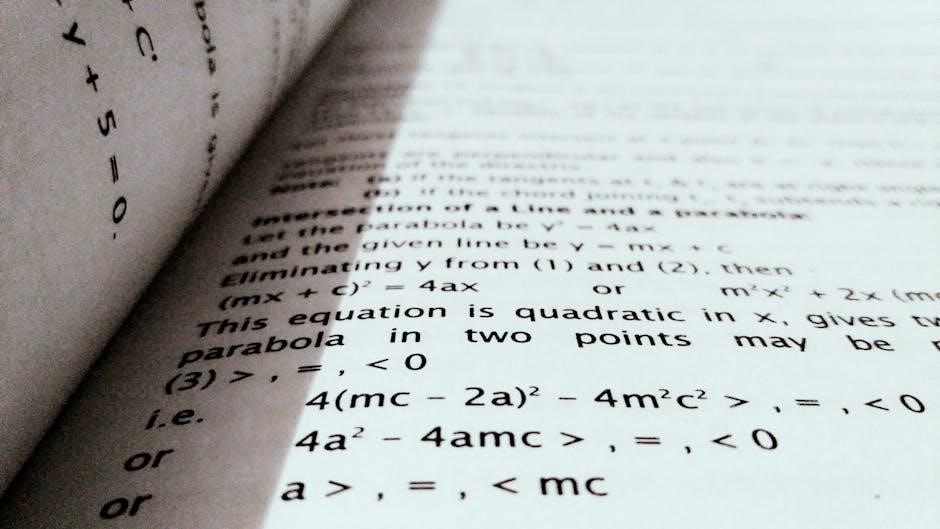
Students learn to determine equivalence classes and understand their significance in various mathematical contexts. Mastering this concept is foundational for advanced topics in calculus and vector analysis, enabling efficient problem-solving and a deeper understanding of set theory.
One-to-One and Onto Functions
The Nelson Calculus and Vectors 12 textbook thoroughly examines one-to-one (injective) and onto (surjective) functions, essential concepts for understanding function behavior and invertibility. Students learn rigorous methods to determine if a function satisfies these properties, utilizing graphical and algebraic techniques. The text emphasizes the importance of domain and range considerations when assessing onto functions.
Understanding these function types is vital for establishing inverse functions, a cornerstone of calculus. The textbook provides numerous examples and practice problems to solidify comprehension, preparing students for advanced applications in limits, derivatives, and vector spaces.
Inverse Trigonometric Functions
The Nelson Calculus and Vectors 12 textbook dedicates a section to inverse trigonometric functions, crucial for solving equations and modeling periodic phenomena. It meticulously defines these functions – arcsine, arccosine, arctangent, and their counterparts – detailing their specific range and domain restrictions. Students learn why these restrictions are necessary to ensure well-defined inverse functions.
The textbook visually reinforces understanding through detailed graphs, illustrating the relationship between trigonometric functions and their inverses. Emphasis is placed on applying these functions in calculus problems, particularly when dealing with integration and differentiation.
Definition, Range, and Domain of Inverse Trigonometric Functions
The Nelson Calculus and Vectors 12 textbook thoroughly explains the definition of inverse trigonometric functions as the inverses of sine, cosine, tangent, and their reciprocals. A key focus is establishing the restricted domains and corresponding ranges necessary for these inverses to be functions – avoiding ambiguity in their outputs.
For example, arcsine is defined only for inputs between -1 and 1, yielding outputs within [-π/2, π/2]. The textbook provides clear examples and exercises to solidify student understanding of these crucial domain and range limitations, essential for accurate calculations.
Graphs of Inverse Trigonometric Functions
The Nelson Calculus and Vectors 12 textbook dedicates significant attention to visually representing inverse trigonometric functions through their graphs. Students learn how these graphs are reflections of the original trigonometric functions across the line y=x, highlighting the domain and range restrictions graphically.

The textbook emphasizes recognizing the unique shapes and characteristics of arcsine, arccosine, and arctangent curves. Detailed diagrams and coordinate plane examples illustrate how these graphs relate to the unit circle and trigonometric identities, fostering a deeper conceptual understanding beyond mere memorization.
Limits
The Nelson Calculus and Vectors 12 textbook introduces the concept of limits as a foundational element of calculus. It meticulously explains how to determine what value a function approaches as its input approaches a certain value, even if the function isn’t defined at that value.
The textbook details limit laws and properties, providing students with the tools to manipulate and calculate limits efficiently. Numerous examples and practice problems demonstrate techniques for evaluating limits, preparing students for more advanced calculus concepts. Understanding limits is crucial for grasping derivatives and integrals.
Understanding the Concept of a Limit
The Nelson Calculus and Vectors 12 textbook carefully builds an understanding of limits, explaining they describe the behavior of a function near a specific input value. It emphasizes that a limit doesn’t necessarily represent the function’s value at that point, but rather where it’s heading.
The text utilizes graphical and numerical approaches to illustrate this concept, helping students visualize how a function’s output changes as its input gets closer and closer to a given number. This foundational understanding is vital for mastering subsequent calculus topics, like derivatives and integrals, built upon this principle.
Limit Laws and Properties
The Nelson Calculus and Vectors 12 textbook systematically presents the fundamental laws governing limits, such as the sum, difference, product, and quotient rules. These laws provide a toolkit for efficiently calculating limits of complex functions by breaking them down into simpler components.
It also details properties like the limit of a constant, and how limits interact with powers and roots. The textbook stresses the importance of understanding these properties to avoid direct substitution when encountering indeterminate forms, preparing students for more advanced limit calculations.
Calculating Limits: Techniques and Examples
The Nelson Calculus and Vectors 12 textbook provides a robust exploration of limit calculation techniques. It begins with direct substitution, then progresses to methods for handling indeterminate forms like 0/0. Students learn to factor, rationalize, and utilize algebraic manipulation to simplify expressions before evaluating limits.
Numerous worked examples illustrate these techniques, covering polynomial, rational, and trigonometric functions. The textbook also introduces L’Hôpital’s Rule as a powerful tool for evaluating limits of indeterminate forms, accompanied by detailed step-by-step solutions to reinforce understanding.

Calculus Fundamentals
This section details core calculus concepts: derivatives, integrals, and their applications, building upon foundational knowledge presented within the Nelson textbook.
Derivatives
The Nelson Calculus and Vectors 12 textbook meticulously covers derivatives, starting with a formal definition of the derivative as the instantaneous rate of change. Students will master essential differentiation rules, including the power rule, product rule, quotient rule, and crucially, the chain rule – vital for complex function analysis.
Beyond computation, the textbook emphasizes applications of derivatives. This includes determining rates of change in various real-world scenarios and tackling optimization problems, where derivatives help find maximum and minimum values. Numerous examples and practice exercises solidify understanding, preparing students for advanced calculus concepts and problem-solving.
Definition of the Derivative
The Nelson Calculus and Vectors 12 textbook introduces the derivative as the limit of a difference quotient, representing the instantaneous rate of change of a function. This foundational concept is explained with clear diagrams and step-by-step examples, building intuition before formalizing the mathematical definition.
Students learn to calculate derivatives using this limit definition, understanding how it relates to the slope of the tangent line at any point on a curve. The textbook emphasizes the connection between the derivative and the function’s behavior, preparing students for more advanced applications and interpretations.
Differentiation Rules (Power, Product, Quotient, Chain Rule)
The Nelson Calculus and Vectors 12 textbook systematically presents essential differentiation rules, streamlining the process of finding derivatives. It begins with the power rule, then progresses to the more complex product, quotient, and chain rules. Each rule is explained with detailed examples and practice exercises.
The textbook emphasizes understanding why these rules work, not just how to apply them. Students learn to identify appropriate rules for various function compositions, building fluency and accuracy in derivative calculations. Numerous worked solutions and self-test questions reinforce mastery of these critical techniques.
Applications of Derivatives: Rates of Change and Optimization
The Nelson Calculus and Vectors 12 textbook expertly demonstrates the practical power of derivatives through real-world applications. A core focus is on understanding rates of change – how quickly quantities are varying – and applying derivatives to model and solve related problems.
Furthermore, the text provides a thorough exploration of optimization techniques, guiding students to find maximum and minimum values of functions. Numerous examples illustrate how to solve practical optimization problems in various fields, solidifying understanding and problem-solving skills.
Integrals
The Nelson Calculus and Vectors 12 textbook presents a comprehensive treatment of integrals, beginning with a conceptual foundation using Riemann Sums to approximate areas under curves. This builds towards the rigorous Fundamental Theorem of Calculus, establishing the link between differentiation and integration.
The text then delves into various integration techniques, including substitution and integration by parts, equipping students with the tools to tackle a wide range of integral problems. Numerous worked examples and practice exercises reinforce understanding and skill development.
Definition of the Integral (Riemann Sums)
The Nelson Calculus and Vectors 12 textbook introduces the integral conceptually through Riemann Sums. This method approximates the area under a curve by dividing it into rectangles and summing their areas. As the width of these rectangles approaches zero, the Riemann Sum converges to the definite integral.
The textbook meticulously explains how to construct and evaluate Riemann Sums, emphasizing the limit process. This foundational approach provides a strong intuitive understanding before formally defining the integral, preparing students for advanced integration techniques and applications.
Fundamental Theorem of Calculus
The Nelson Calculus and Vectors 12 textbook presents the Fundamental Theorem of Calculus as a cornerstone of calculus, bridging differentiation and integration. It demonstrates that differentiation and integration are inverse processes, establishing a crucial link between these two core concepts.
The textbook thoroughly explains both parts of the theorem: how to evaluate definite integrals using antiderivatives, and how derivatives relate to integral functions. Numerous examples and practice problems solidify understanding, enabling students to confidently apply this powerful theorem to solve a wide range of calculus problems.
Integration Techniques (Substitution, Integration by Parts)
The Nelson Calculus and Vectors 12 textbook dedicates significant attention to mastering integration techniques. It systematically introduces u-substitution, guiding students through identifying appropriate substitutions to simplify complex integrals. Detailed examples illustrate the process, building confidence in applying this versatile method.
Furthermore, the text comprehensively covers integration by parts, explaining its application to integrals of products of functions. Clear explanations of the LIATE rule (Logarithmic, Inverse trigonometric, Algebraic, Trigonometric, Exponential) aid in selecting the correct function for ‘u’. Practice exercises reinforce proficiency in both techniques.

Vectors in Three Dimensions
This section of the Nelson textbook delves into vector operations – scalar multiplication, addition, subtraction – and explores dot and cross products in 3D space.
Vector Operations
The Nelson Calculus and Vectors 12 textbook provides a thorough exploration of fundamental vector operations within a three-dimensional coordinate system. Students will learn to perform scalar multiplication, effectively scaling the magnitude of a vector. Furthermore, the text details vector addition and subtraction, demonstrating how to combine or find the difference between vectors to represent resultant forces or displacements.
Crucially, the textbook introduces the dot product, explaining its use in determining the angle between vectors and projecting one vector onto another. Conversely, the cross product is presented as a method for finding a vector perpendicular to two given vectors, with applications in calculating areas and volumes. These operations form the bedrock for understanding more complex vector applications.
Scalar Multiplication and Vector Addition/Subtraction

The Nelson Calculus and Vectors 12 textbook meticulously covers scalar multiplication, demonstrating how multiplying a vector by a scalar alters its magnitude, potentially reversing its direction. Vector addition is explained through methods like the parallelogram law and the triangle law, visually representing how vectors combine to form a resultant vector.
Subtraction is presented as the addition of a negative vector, reinforcing the concept of direction. The textbook emphasizes the importance of component-wise operations for both, simplifying calculations in three-dimensional space. Numerous examples illustrate these concepts, building a strong foundation for more advanced vector manipulations.
Dot Product and Cross Product
The Nelson Calculus and Vectors 12 textbook provides a detailed exploration of both the dot and cross products of vectors. The dot product is presented as a scalar quantity revealing information about the angle between vectors and their projections, crucial for calculating work done by a force.
Conversely, the cross product is explained as yielding a vector perpendicular to the original two, with magnitude representing the area of the parallelogram they define. The textbook thoroughly covers the geometric and algebraic interpretations of each, alongside practical applications in physics and engineering, solidifying understanding.
Applications of Vectors
The Nelson Calculus and Vectors 12 textbook emphasizes the practical relevance of vectors, showcasing their applications in diverse fields. It details how vectors facilitate the geometric representation of physical quantities like force, velocity, and displacement, enabling clearer problem-solving.
Furthermore, the text demonstrates how vector equations are used to define lines and planes in three-dimensional space, a fundamental concept in spatial reasoning. Real-world examples, likely including navigation and physics problems, are integrated to illustrate these concepts, fostering a deeper comprehension of vector utility;
Geometric Representation of Vectors
The Nelson Calculus and Vectors 12 textbook utilizes visual learning by extensively employing the geometric representation of vectors. Students learn to visualize vectors as directed line segments, understanding their magnitude and direction as crucial components. This approach aids in grasping vector addition and subtraction through techniques like the parallelogram rule and the triangle law.
The textbook likely includes diagrams and exercises focused on interpreting vectors graphically, solidifying the connection between algebraic representation and spatial understanding. This foundation is essential for tackling more complex vector operations and applications.
Vector Equations of Lines and Planes
The Nelson Calculus and Vectors 12 textbook delves into representing lines and planes using vector equations, a core concept in three-dimensional geometry. Students learn how to define a line using a position vector and a direction vector, enabling them to determine any point on the line. Similarly, the textbook explains how to represent a plane using a normal vector and a point on the plane.
Expect numerous examples and practice problems demonstrating how to convert between vector and parametric equations, and how to determine relationships between lines and planes – such as parallelism and intersection.

Resources and Support
Nelson Education’s website provides supplementary materials, while online forums offer a collaborative learning environment for students using this calculus and vectors textbook.

Nelson Education Website and Support Materials
The Nelson Education website serves as a central hub for resources complementing the Calculus and Vectors 12 textbook. Students can access additional practice questions, fully worked solutions, and interactive tutorials designed to reinforce key concepts. These materials are specifically tailored to align with the textbook’s content, offering targeted support where needed.
Furthermore, the website often provides downloadable chapter tests and review materials, aiding in exam preparation. Educators benefit from teacher resources, including lesson plans, assessment tools, and professional development opportunities. Nelson’s commitment extends beyond the textbook itself, fostering a comprehensive learning experience for both students and instructors utilizing this valuable resource.
Online Forums and Communities for Textbook Users

Numerous online forums and communities provide valuable support for students and teachers using the Nelson Calculus and Vectors 12 textbook. Platforms like Reddit (specifically subreddits dedicated to mathematics or the textbook) and dedicated student forums offer spaces to ask questions, share solutions, and discuss challenging concepts.
These communities foster collaborative learning, allowing users to benefit from the collective knowledge of peers. Many forums also feature experienced tutors or instructors who can provide guidance. Engaging with these online resources can significantly enhance understanding and problem-solving skills, supplementing the textbook’s content with real-time assistance and diverse perspectives.